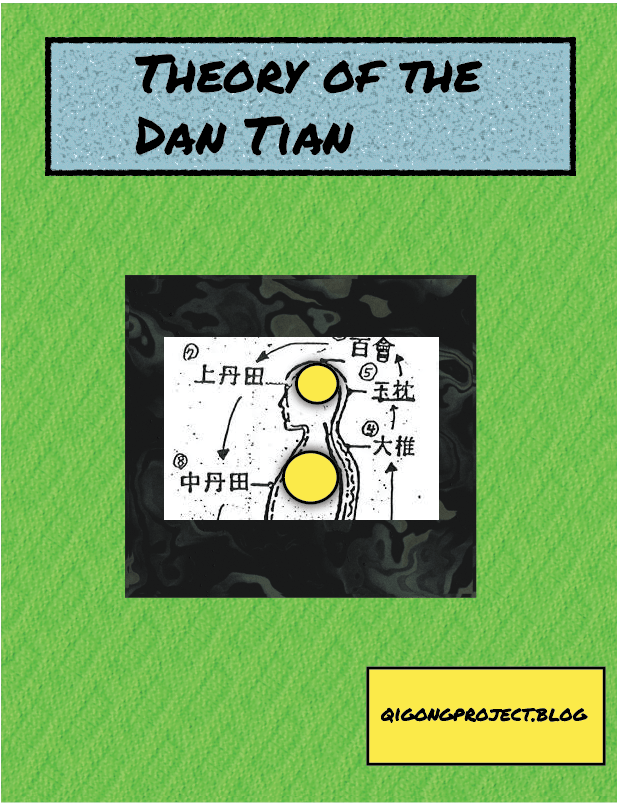
This page is dedicated to the theory of the Dan Tian in Modern Qigong Culture. Here you will find its meaning, history, theory and proposed function in Qigong.
Meaning of the Dan Tian
Dan Tian (丹田) means Elixir Field and is a Qigong concept derived from Daoist Qi Methods (气法).
In the context of Qigong the term refers to three energetic centers of the body located in the head, chest and abdomen.
The Three Dan Tian are:
- 上丹田 Shang Dan Tian/Upper Elixir Field: The Upper Field is located in the brain and is the seat of human mental functions and Spiritual Awareness.
- 中丹田 Zhong Dan Tian/Middle Elixir Field: The Middle Field is commonly considered to be located in the chest and is associated with the Heart and Lungs as well as circulatory and pulmonary functions.
- 下丹田 Xia Dan Tian/Lower Elixir Field: The Lower Field is located in the Lower Abdomen between the Umbilicus and Genitals and is associated with digestive organs and sexual function.
A Brief History of the Dan Tian:
100 B.C. – 400 A.D.
The Dan Tian is a Daoist concept who’s earliest known mention is in the Laozi Steele (老子铭) which calls the Dan Tian “A Great Purple Room.”
In the Huang Ting Jing/Yellow Court Classic (黄庭经) by Daoist Wei Huacun (魏华存) especially elaborated on the abdomen Dan Tian area by contributing ideas about its anatomical and physiological function relative to Daoist Visualization practice and breathwork.
It was elaborated on in the Bao Pu Zi/Master of Simplicity (抱朴子), a Daoist text which established the Three Dan Tian model of the Head, Chest, and Abdomen.
400 – 1800 A.D.
the concept of Dan Tian was developed in multiple schools of Daoism including breathing practices and Internal Alchemy with several unique interpretations of the concept relative to goals of practice.
1800 – 1950 A.D.
During this period the concept of Dan Tian began to be applied in the Internal Martial Arts of Taiji Quan, Xingyi Quan, and Bagua Zhang.
The Martial Arts theory of the Dan Tian especially emphasizes the concept of the Lower Field as the physical center of balance of the body.
During this time the modernist meditation writer Jiang Wei Qiao contributed new ideas to the study of Dan Tian such as that Qi could be circulated from the Lower Dan Tian to the rest of the body because stagnant blood was pushed out of the intestines as a result of mental attention on the Lower Dan Tian during meditation.
1950 – Present
The concept of Dan Tian was established as a major theory of modern Qigong and is typically used to describe the energetic function of the centers in the head, chest and abdomen in their mediation of physical essence, Qi, and spiritual awareness.
Various Qigong schools, teachers and researchers have established unique theories of the Dan Tian relative to the individual concepts of their arts.
Dan Tian Theory:
1: Lower Dan Tian
The Lower Dan Tian is usually considered to be located in the Lower Abdomen between the Umbilicus and genitals.
It is considered to be the location of the Jing/Essence of the body (精).
The Essence may be viewed as a combination of physical fluids, sexual materials, hormones present in the abdomen and its organs, and physical tissue.
The Lower Dan Tian is also considered to be the physical center of balance and is used to center mental focus during Qigong practice in order to collect Qi and Spiritual Awareness.
The Lower Dan Tian also has the function of causing Qi to move in the body during certain types of Qigong practice such as Jing Gong/Stillness Work (静功).
Many Qigong systems begin and end practice by collecting attention in the Lower Dan Tian area in order to facilitate movement from the center of the body and stop energy from circulating respectively.
In Summary, the Lower Dan Tian serves the function of collection, storage, and activation of Qi, is the location of the physical essence and the center of balance of the body.
2:Middle Dan Tian
The Middle Dan Tian is usually considered to be in the chest center and is a general circumference of the chest front and interior around the level of the breasts, nipples, and sternum.
The Middle Dan Tian is level with the Heart and Lungs and is considered to govern Qi in the body since the concept of Qi in Qigong culture is related to circulation of blood around the body.
The Middle Dan Tian is the area where breath comes and goes from the lungs and fuels the blood with oxygen.
The oxygen is pumped by the heart around the body and nourishes all physical tissues then the blood collects Co2 and returns it to the heart and lungs to expel via exhalation.
The entire cardiac and pulmonary system function relies on the chest and lungs, thus the Middle Dan Tian serves as the general area in which the breathing and circulation take place and as such as associated with Qi physiology.
3:Upper Dan Tian
The Upper Dan Tian is the general area of the brain and skull interior.
The brain is the main location of cognition and the manager of the nervous system, thus the Upper Dan Tian is associated with Spiritual Awareness (神/Shen).
The Use of the Dan Tian in Qigong:
Modern Qigong views the Three Dan Tian primarily as storage points for Qi and has various practices used to generate and collect Qi within the Dan Tian centers so it can penetrate the internal organs.
Because Qigong mainly uses Dong Gong/Moving Practice and Jing Gong/Stillness Practice the uses of the Dan Tian may vary relative to methods employed.
Popular Methods of Dan Tian Cultivation in Qigong
Below are a few popular methods of cultivating the Dan Tian in modern Qigong practice. Of course there are also many more and if you would like one added to the list by all means make a recommendation and we’ll consider putting it up as long as it fits with the mission of the site.
意守丹田 Yi Shou Dan Tian/Protect the Mind in the Dan Tian
In this method practitioners use mental intention to focus on one or more Dan Tian centers.
This may be done together with specialized breathing practices or simply through mental focus.
This method of practice is typically used to collect Qi in the Lower Dan Tian but can also be used to observe the Upper or Middle Dan Tian in order to attract Qi or physical relaxation to those areas.
沉气丹田 Chen Qi Dan Tian/Sink the Qi to the Dan Tian
This method is usually incorporated in the Martial Arts but some Qigong practitioners also use it.
It is achieved by taking a rooted posture and sinking the hips and tailbone toward the ground while relaxing the Lower Back.
This technique is borrowed from Martial Arts Practices such as 站桩 Zhan Zhuang/Standing Post.
For instance in the 智能气功三心并 Zhi Neng Qigong San Xin Bing Zhuang Post Standing method the posture is derived from a standing posture from the 形意拳 Xing Yi Quan Martial Art style.
Sinking the Qi to the Dan Tian is a technique of physically sinking and relaxing the Lower Abdomen and back so the spine lengthens and a sense of Qi enters the Lower Dan Tian region.
丹田充实法 Dan Tian Chong Shi Fa/Dan Tian Activation Method
This is also derived from Xingyi Quan Qigong and involves the use of 吐纳 Tu Na Breathing Methods to activate the Lower Dan Tian so the Qi travels up the Spine to the Upper Dan Tian and back down the front of the body to the Middle and Lower Dan Tian.
丹田呼吸 Dan Tian Hu Xi/Dan Tian Breathing
Many types of Dan Tian breathing may be used to activate the Lower and Middle Dan Tian in order to collect and generate Qi movement.
These can include:
- 顺呼吸 Shun Hu Xi/Smooth Breathing: the abdomen expands on the in breath and relaxes inward on out breath,
- 逆呼吸 Ni Hu Xi/Reverse Breathing: the abdomen draws inward on the in breath and relaxes outward on the out breath,
- 胸呼吸 Xiong Hu Xi/Chest Breathing: the breath fills the chest.
- 闭息 Bi Xi/Sealing the Breath: the inhalation is held within the abdomen and slowly released via the mouth.
- 吐纳 Tu Na/Spitting and Grasping: the nose breathes in and mouth breathes out. This can include Bi Xi or making various sounds on exhalation.
真气运行法 Zhen Qi Yun Xing Fa/True Qi Circulation Method
This modern Qigong method uses mental intention and breath work to activate the 小周天 Xiao Zhou Tian/Microcosmic Orbit which connects the Upper, Middle and Lower Dan Tian as well as the Ren Meridian (任脉 Ren Mai) and Du Meridian (督脉 Du Mai) which vertically connect the front and back of the body.
It is also used to activate the Three Dan Tian and fill them with Qi and is one of many Qigong systems to make the claim of performing the Daoist Alchemy method of:
- 炼精化气 Lian Jing Hua Qi/Refining the Essence and Transforming Qi,
- 炼气化神 Lian Qi Hua Shen/Refining the Qi and Transforming Spirit,
- 炼神化虚 Lian Shen Hua Xu/Refining the Spirit and Transforming Void.
Although the Qigong approach to this has many important differences with Daoist practice it still retains similar language to describe its function.
Summary:
To sum up, the concept of Dan Tian in Modern Qigong practice borrows from Daoist energetic ideas but is based on different principles including its function in storing energy, rooting the body, and helping to bring Qi to the Internal Organs.
In the near future I will add a Dan Tian section to the Daoist Qigong page so you can better understand the difference between the use of this concept in the two schools.
Are you enjoying Qigong project?
Why not make a small donation to help us get better equipment so we can make even better media. You can make a one time or recurring donation of any amount you want and it would really help us keep this project moving full steam ahead so it can help clarify the exciting genre of Qigong for the community!!
Make a one-time donation
Make a monthly donation
Make a yearly donation
Choose an amount
Or enter a custom amount
Your contribution is appreciated.
Your contribution is appreciated.
Your contribution is appreciated.
DonateDonate monthlyDonate yearly Qigong Project