This page will soon contain links to other pages explaining the full theory of Qigong.
While we work on it we’d like to offer an introduction to the meaning of the term Qigong, so please read on to find out more.
The meaning of Qigong
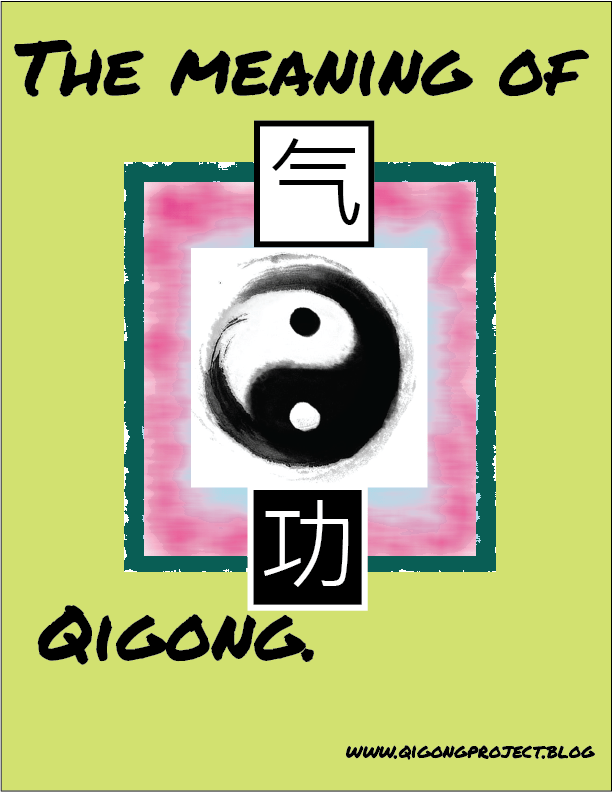
Qigong is a term made up of two Chinese Hanzi pictographs:
- 气 Qi
- 功 Gong,
To understand how Qigong works we must first discover the meanings of these two characters.
Qi, an ancient word
The word Qi is an ancient character which may have appeared as early as 3000 years ago.
Its original meaning described smoke rising from a fire or steam rising from boiling water.
The meaning eventually transformed to refer to many phenomena in the atmosphere and environment.
Because the term Qi has many applications it can be difficult for people who don’t read Chinese to understand exactly what it means in fields such as Qigong, Medicine, Daoism, and Martial Arts.
This leads some people to believe that the term can be applied uniformly across every genre, but this is not the case.
Gong, a skill obtained through effort
The character Gong 功 is made up of the pictographs 工 Gong, which means work and 力 Li, which means strength.
Therefore Gong means something like work and effort with the implication that after working hard at a skill for a long time a person can become good at it.
Qigong, the skill of Qi
Thus when we put Qi 气 and Gong功 together we get Qigong 气功, the Skill of Qi.
This is our first hint about the meaning of the term Qigong, since it implies that we are working with Qi in order to become good at using it over time.
How to define Qi
Since the term Qi has so many definitions it can be hard to decide exactly how we should define Qigong, but the good news is that we can obtain a few clues from a quick historical analysis of the genre.
Qigong culture has ancient roots and modern origins
Before the 1950s there was no standard term to describe Qigong, in fact in old times practices which we call Qigong today might have been called:
- Dao Yin/Leading and Stretching,
- Tu Na/Spitting and Grasping,
- Cun Si/Containing the Mind,
- Shou Qiao/Protecting the Cavities,
- Jing Zuo/Sitting in Stillness,
- and many other names.
However, broadly Qigong would have been defined as 修炼 Xiu Lian/Cultivating and Refining.
Because there were so many unique methods and styles and none of them were standardized there was no singular theoretical model available to summarize them.
After Qigong began to be standardized in the 1950s teams of researchers and masters began to systematize its theory and develop a universal model of Qigong which could be applied across all styles.
This was how it came to be the case that the modern categories of Qigong were established.
They include:
- Qigong for health: this is usually what we just call Qigong today and includes most modern styles (note: Qigong for health and health Qigong are generic terms used in North America and do not refer to any one specific or trade marked style).
- Martial Arts Qigong: those Qigong practices done by Martial Artists to improve their skill and prevent injury,
- Medical Qigong: Qigong practices done by Chinese Medicine Practitioners to help treat illness without medicine,
- Religious Qigong: Qigong practiced for religious or spiritual purposes by Daoists and Buddhists (as well as Confucian Qigong practices).
Since each of these genres of practice is used for specific reasons, the way they define terms varies relative to the stated goal of their practice.
Typically today when we use the term Qigong we usually use it to mean health Qigong, which itself already has three generations of development, each having significant differences with the others.
No, really, how do you define Qi?
Now that we know a little more about how Qigong styles differ it may seem even harder to understand exactly what Qi is, but if we simplify our analysis and only view modern Health Qigong our job becomes much easier.
The term Qi in Qigong refers to any type of Qi that can be manipulated through mental and physical activities.
These generally include:
- Using intention to lead Qi sensations to various parts of the body either while in meditation or performing movements,
- Respiration techniques which increase sensations of Qi in the body,
- Specific visualization practices to encourage Qi to move in the body,
- Self massage which can break up stagnant areas and cause Qi to move,
- and various other practices that cause Qi to move, circulate or accumulate in the body.
With this in mind our options about what Qi is become more manageable and include:
- Qi in blood: the Qi which moves in our blood is a combination of oxygen, co2, and food based nutrition and may be stimulated through breath work, intentional movement, and even stillness meditation,
- Qi in organs: the Qi of specific organs can be adjusted through the use of intention to generate sensation in the body and improve the function of life systems associated with them. For instance visualizing black mist in the kidneys during meditation has been used for hundreds of years in Daoism and Chinese Medicine to relax the lower back, improve urination and sexual function, and regain lost energy,
- Breath Qi: breathing exercises and movement can be used to stimulate the breath in order to bring in more oxygen and get rid of more co2, leading to increased mental clarity, relaxation and physical comfort,
- Qi of the nervous system: Qi in blood has a direct relationship with the nervous system since more oxygen rich blood which circulates more smoothly can improve overall nervous system function and increase cognitive abilities.
- Meridian Qi: the Qi which moves in the energetic meridians of the body if called True Qi and is essential to good Qigong practice but takes years of dedicated study and practice to truly understand since it does not conform to modern anatomical views of biomedicine as it has not been properly researched from that perspective.
- Random sensations: people who practice Qigong may also experience random sensations such as vibrating, warmth, cold, numbness, etc… These sensations are normally temporary and can be positive, negative or neutral, sometimes indicating practice is going in the right direction and sometimes showing problems with a person’s practice relative to intensity, how long they last and whether or not they are comfortable.
You may have noticed there was no magic
The above list was not exhaustive, but it should give you a good idea of some of the real types of Qi and Qi sensation experienced in modern Health Qigong.
You may notice that none of these manifestations of Qi had anything to do with black or white magic, no bio-electric energy, and nothing particularly mysterious.
Instead they are all things you can experience through practice and which may become more pronounced as your practice improves, thus leading us to a final conclusion about the meaning of the term Qigong.
Qigong means the skill of using Qi that we develop after years of effort.
I hope you found this introduction to the meaning of QIgong useful.
I plan on significantly increasing this section on Qigong theory in the near future so that it includes all the information you need to make progress in your practice regardless of style.
I also plan to offer some small courses about specific types of Qigong such as Daoist Dao Yin, Small Heavenly Orbit Qigong, and Meditation on the site sometime in the next few months.
Are you enjoying Qigong project? Do you want to help use make it better?
Why not consider making a small donation to the page so we can keep developing better and more interactive content. Donations start at as little as $5 and we are deeply thankful to everyone who contributes.
Make a one-time donation
Make a monthly donation
Make a yearly donation
Choose an amount
Or enter a custom amount
Your contribution is appreciated.
Your contribution is appreciated.
Your contribution is appreciated.
DonateDonate monthlyDonate yearly Qigong Project