By Robert.
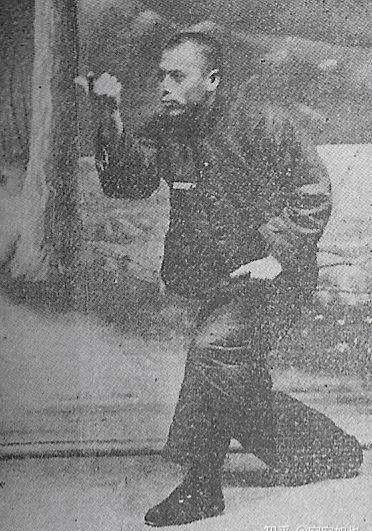
There is an old Martial Arts proverb:
练拳不练功到老一场空
If you practice Martial Arts without refining skill in old age it will all be in vain.
One of my main jobs at Qigong Project is to promote genuine Qigong and a major part of this is in explaining what is not Qigong.
The above quote has been used for decades by Qigong teachers who also practice Martial Arts (especially Taijiquan) to claim that Taiji practitioners must also practice Qigong.
This isn’t just a Western thing, it is also quite a common idea in China, but it is a serious misinterpretation of what the term 功 Gong/Skill means in the Martial Arts.
The term Gong is made up of two halves:
- 工 Gong/Work: This denotes putting work into a skill over time so it matures.
- 力 Li/Strength: This denotes the use of your physical and mental powers to perform work.
Together Work and Strength produce Skill, which is the meaning of Gong.
We shouldn’t make the mistake of assuming that strength refers only to physical power in this case, or that strength is the only important part of martial arts, since of course we also need speed, flexibility, dexterity, perceptual skill and many other attributes to be good martial artists, so strength in this sense means how much effort we put into practice every day.
Thus the saying “if you practice martial arts without refining skill in old age will all be in vain ” means that if you only practice martial techniques and you do not work on practices that improve the other attributes of practice you will not be able to maintain your martial ability as you get older.
You might ask, what is martial skill practice then, and what does it have to do with Qigong?
This is a good question because it brings us into the territory where we can actually get a sense of what Martial Arts Qigong really is and isn’t.
Martial Skill is anything which serves the purpose of martial training and in the context of Chinese Martial Arts Culture there are several characteristics that make up skill:
- Self defense skill: the ability to defend yourself is the main purpose of martial arts so any good martial artist must know how to apply their art against an attacker.
- Physical and mental development: the attributes of strength, speed, flexibility, stamina, dexterity, mental acuity, physical relationship with opponents etc… are all aspects of physical development. Although self defense is the primary objective of martial arts, physical and mental development are the main way to obtain those skills.
- Physical and mental health: Chinese Martial Arts often place emphasis on attaining physical and mental wellbeing as a result of correct practice. The goal of martial arts is not to become a champion and retire at 32 unable to walk properly, it is to practice until you are in old age and enjoy the joy that strength, speed, flexibility, dexterity and mental acuity provide you when most other people are in decline.
- Performance: many martial “realists” don’t like the idea of performative aspects of Chinese Martial Arts, but they have always been part of the practice and serve several important functions such as appraisal of basic skills, verification of lineage, and of course as a beautiful performative art form that is aesthetically pleasant to watch. Performance quality relies on strength, speed, flexibility, dexterity, mental acuity, and expressiveness.
Thus you can see that among each of the categories listed above it is those qualities of strength, speed, flexibility, dexterity and mental acuity that define the skill set of the martial arts regardless of which dimension of practice is under consideration.
So how are those things trained? I thought you were going to tell us about martial Qigong?
Those skills are trained in the following ways:
- 基本功 Jiben Gong/Foundational Skills: punching, kicking, blocking, practicing force and speed exercises, and repetitive single movements all qualify as basic skill cultivation.
- 内功 Nei Gong/Inner Skill: stretching, rotating joints, relaxing muscles, posture work, all of these things comprise the requirements we need to have an elastic, strong and healthy posture and good movement dynamics.
- 外功 Wai Gong/External Skill: strength and speed conditioning, running, lifting weights, doing sit ups, push ups, pull ups and other similar practices build raw power, speed and stamina needed to practice martial arts at a high level.
- Other Methods: routine practice, weapons, partner work and many other elements also inform our skill development.
Where Qigong fits:
In the Martial Arts there are two practices which can be understood as Qigong, the first is Neigong which is the stretching and relaxing practice mentioned above and the other is art specific Qigong which develops the internal energy of practitioners to help them enhance their vitality, recover from training injuries, focus their minds and of course realize their energetic potential.
Neigong is taught to all practitioners whereas Qigong is sometimes kept as a lineage secret or advanced practice only available for disciples.
It is also common for Qigong to be taught to harden the body such as in the practice of Iron Fist and Iron Body.
Martial Arts Qigong is quite complex since it is usually adopted to meet the requirements of specific styles, so the Qigong practiced by Taijiquan practitioners might be used to advance attributes such as softness and subtle movement while Shaolin Qigong often emphasizes strengthening deep muscles around joints in order to provide more power and toughness.
In old times Martial Qigong was typically referred to as Neigong and only since the rise of Qigong culture in the 1950s has the term Qigong been used in the Martial Arts.
This has been complicated by the similarity of classic methods like Ba Duan Jin and Yi Jin Jing to non martial variations of the same arts.
It is only in modern times that we call Ba Duan Jin or Yi Jin Jing as Qigong, actually before the 1950s that term was never used to describe those arts and they would only have been called Neigong if it was specifically applied within the context of the Martial Arts.
Another problem has come up with the adoption of modern Qigong methods into arts such as Taijiquan. When I first started studying Middle Frame Yang Style from Shen Zaiwen’s lineage my teachers and classmates would often say that practicing Shen’s Taiji Qigong set was required to be good at Taijiquan practice, but later when I learned the same style from Yin Qin in Shanghai he taught a completely different approach in which Dao Yin was a major feature of practice taught to indoor disciples but where the energetic results of practice came from proper movement, posture, breathing and basics during regular form practice.
I’m not trying to say one is right and one is wrong, but rather where the Gong is located varies between styles.
Shen Zaiwen’s Taiji is mainly a health practice and Yin Qin likes to poke people in the eyes and throw them on the floor so of course their interpretations are different.
Summary:
To sum up my thoughts, if you have come to this site and already have high context about the nature of Qigong as a modern phenomenon then none of this will have been new news to you. I suspect you may think that I missed important points and that you have your own take which may vary considerably from mine and that’s to be expected.
However, many people practice Qigong for a very long time without ever really looking into the complexity of the genre and often come off with wildly inaccurate ideas about what it is, where it is useful and how it is applied.
My take based on twenty years of practice and reasonably diligent research is that the word Qigong is often poorly defined even in China and is often used in a procrustian way that only adds confusion to the public discussion about these arts.
My current understanding is that pretty much every type of Dao Yin, Neigong, and breathwork that existed before 1955 was not originally called Qigong and so now that modern Qigong has had such a large impact it often seeps into places where it doesn’t really belong.
That is to say that Martial Arts Qigong which doesn’t serve martial purposes isn’t really Martial Arts Qigong, it is some other kind of Qigong.
Just so, Daoist Qigong which doesn’t emphasize a Daoist approach isn’t Daoist Qigong, Chinese Medicine Qigong without fundamental understanding of Chinese Medicine theory isn’t Chinese Medicine Qigong and so on.
This might be a lot to take in right now, but trust me once this site is better developed I’ll be backing this up with a lot of evidence.
The biggest category of Qigong is modern qigong of which there are hundreds of styles. Most Qigong is modern Qigong and in my opinion it is better than almost any other kind of Qigong because it has its own specific use and ideology which other schools tend to miss out on.
Having said that if you are looking for specific results such as attaining the Dao or healing from illness then you might be better suited to other variations of Qigong.
Just so, if you want to be a great martial artist and know how to defend yourself, have a strong and flexible body and keen mind, keep your skill in old age and maintain vitality all while looking cool doing it, then you better keep working on your Gong and don’t just do forms and applications, otherwise it will all come to nothing as the adage says.

 Qigong Project