Dao Yin is among the oldest styles of Qigong practice and has been used by Daoists, in Chinese Medicine and by common people for at least 2400 years.
In this article we are going to have a quick look at what constitutes Daoist Dao Yin and what this means to modern Qigong culture.
Introduction:
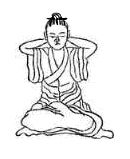
导引 Dao Yin means Leading and Stretching and is a popular form of exercise practiced since pre-dynastic times in China.
The earliest known mention of Dao Yin is in the 南华经 Nan Hua Jing, also known as the Zhuangzi:
吹呴呼吸,吐故纳新,熊经鸟申,为寿而已矣,此道引之士,养形之人,彭祖寿考者之所好也。
“making huffing and puffing sounds when they breathe, spitting out the old and grasping the new, bending their backs like bears and extending their chests like birds, they believe this gives them long life. These practitioners of Dao Yin are people who nurture their bodies and would like to extend their lives to the same length as Peng Zu.”
Zhuangzi outer chapters, Ke Yi chapter.
Although this text is often viewed by modern scholars as a pejorative statement against the practice of stretching and rotating the body, it was used variously throughout Daoist history as evidence of a long tradition of practice in order to legitimate Dao Yin.
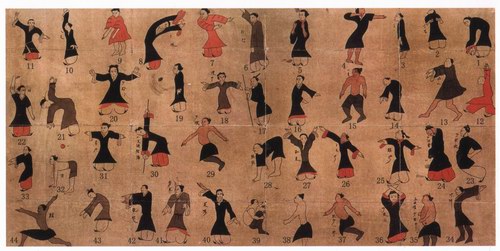
Another early reference is the 导引图 Dao Yin Diagram, a pictorial representation of stretching postures produced sometime during the Warring States period or early Han Dynasty before 220 B.C.
The text was excavated in the mid 20th century at the Han Dynasty Ma Wang Dui Funerary Complex, an archaeological site in Changsha Hunan and was found alongside early Chinese Medicine, Astrology and Breath Work Classics indicating that intellectuals of the time were interested in the study of longevity arts and astrology.
Dao Yin has existed in China in multiple forms over the past 2500 years and is included in Chinese Medicine, Daoism and Folk practice, but today I would like to specifically focus on Daoist conceptions of Dao Yin and discuss the Daoist approach to practice.
1: Dao Yin and Massage
The 黄帝内经 Yellow Emperor Internal Classic refers to Dao Yin as 导引按跷 Dao Yin An Qiao/Leading, Stretching, Pressing and Lifting, a Chinese Medicine practice in which acupressure and assisted stretching are used to obtain therapeutic benefits.
We can see that Dao Yin as a concept has historically been treated in diverse ways and is often associated with self massage and therapist assisted massage.
The Sui Dynasty Daoist and Doctor 孙思邈 Sun Simiao recorded the 老子按摩法 Laozi Anmo Fa/Laozi Massage Method, a series of stretching and self massage techniques used to limber up the body as part of his broader collection of self nourishing techniques in his medical corpus.
This highlights Dao Yin as an auto-therapy and active exercise which could be paired with various breathing practices to produce physical relaxation and pain relief.
2: Dao Yin as a static practice
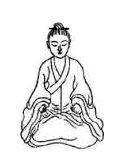
The more common variation of Daoist Dao Yin is performed as a static practice, often done seated.
This practice includes styles such as 十六段锦 Shi Liu Duan Jin/The Sixteen Silk Brocades which are sixteen seated practices which range from seated meditation, posture holding, slight stretching, and self massage and were variously popular in Daoism and folk traditions throughout Chinese history.
3: Dao Yin as a moving practice
The Daoist thinker 陶弘景 Tao Hongjing lived during the Northern and Southern Dynasty period and penned the text 养性延命录 Yang Xing Yan Ming Lu/Nurturing Nature and Extending Life Records in which he presented the 五禽戏 Wu Qin Xi/Five Animal Performances (also known as Five Animal Frolics), a set of moving Dao Yin practices imitating the movements of Monkeys, Bears, Cranes, Deer and Tigers.
This practice involved postures done while standing and crouching and was meant to invigorate and exercise the body to attain ideal circulation of Qi and blood.
4: The two traditions of Daoist Dao Yin
by reviewing the above information we can see that Daoist Dao Yin traditionally included two types of Dao Yin, one performed while seated and with only a very limited number of movements and another performed while standing with more diverse movements.
The purpose of the styles is different since the practice with less movements was usually performed as a means of integrating meditation with self massage, while the method with more movements was designed to stimulate circulation.
These approaches are different in character and produce radically different results, meaning they are both useful to have in one’s Qigong repertoir.
5: Modern adaptations of Daoist Dao Yin
In modern times Daoist Dao Yin practices have been interpreted in new contexts outside of the Daoist tradition leading to arts such as the Five Animal Performances and Eight Silk Brocades being performed at a tempo and style similar to the soft flowing movements of Simplified Taijiquan.
This was partly a result of evolution of the practices among the folk and partly due to Qigong exercise development committees established by the Chinese departments of health and sport.
Until the 1990s Qigong was overseen by the Health department, but today it is controlled by the department of Sport.
This means that standard Qigong routines have evolved over time to resemble dance routines inspired by Taijiquan and bear almost no resemblance to the traditions they emerged from.
This is especially true of modern interpretations of Daoist Dao Yin Methods such as The Eight Silk Brocades which have transitioned from a set of seated exercises performed in stillness to fundamental stretches practiced in a dynamic standing posture.
While there is some evidence that the practice had a Northern variant which was done standing, there is no question that the modern variation of the Eight Silk Brocades has little relationship with the medieval practice of the Sixteen and Twenty Four Silk Brocade Dao Yin practices made popular over 1000 years ago during the Chinese Song Dynasty.
6: Daoist Qigong and Dao Yin
The situation of Daoist Dao Yin is further complicated by the adoption of modern Qigong practices by Daoists at mountains such as Wudang.
Part of the corporate strategy of Daoist tourist locations is to use Taijiquan and Qigong as instructional products to promote Daoist temples.
This business model relies on historical misrepresentation in which the Wudang style of Taijiquan is linked to the Daoist Zhang Sanfeng who lived at the mountain nearly 1000 years ago.
Since the Wudang style of Taijiquan is a combination of the Five Families of Yang Style, Chen Style Old and New Routines, Sun Style, Hao Style, and Wu Style, all of which are modern forms of practice, it is almost impossible that Wudang Taiji could have come directly through Zhang Sanfeng to the mountain without first making several stops in Henan and Beijing over the centuries.
The same is broadly true of Daoist Qigong practice at commercial temples since it borrows from many of the theories of modern Qigong such as the adoption of Taijiquan style movements and the language and terminology of modern Qigong.
At the same time there are still Daoists in China and the Chinese diaspora who practice traditional Daoist Dao Yin Methods and it can be difficult for neophytes and advanced students alike to clearly differentiate what practices are authentic to the Daoist traditions and which ones are derived from post revolution Qigong.
7: Researching Daoist Dao Yin documents may help in clarifying the nature of the genre
Since the modern Qigong marketplace is full of contradictory and confusing information it may be beneficial for people wishing to study and understand Daoist methods to make a literature review of old Dao Yin documents to understand the type of practices used in the genre.
This can be paired with the study of modern Qigong theory to help verify where changes have taken place.
This is a difficult task even for fluent Chinese readers since most medieval Daoist documents are written in terse and coded language, but it could have great benefit in moving the genre forward in the west.
Conclusion
Qigong Project is dedicated to the research and dissemination of accurate information about Qigong in all of its forms.
One of our greatest interests is Daoist Dao Yin practice and we plan to offer courses in Dao Yin document reading starting mid November which will be available as premium content on this site.
We believe that by clarifying the history, theory, and components of traditional Qigong it is possible to create a non superstitious and more beneficial understanding of the practice of Qigong and improve the community.
Thank you very much for reading this article, I hope you found it useful!
Please consider making a one-time donation to Qigong Project
Make a monthly donation
Make a yearly donation
Choose an amount
Or enter a custom amount
Your contribution is appreciated.
Your contribution is appreciated.
Your contribution is appreciated.
DonateDonate monthlyDonate yearly
 Qigong Project
Muchas gracias por la información maravillosa🤛🙌
LikeLike